
New Report Investigates a Warehouse Fire Near Miss Incident
A new report from UL Research Institute’s Fire Safety Research Institute examines a near miss incident involving a warehouse fire in Chula Vista, California. The report provides a detailed near miss incident analysis and offers practical guidance for firefighters operating in commercial buildings. This analysis highlights the major findings and explains how applying fire dynamics principles in commercial fires can strengthen safety and tactical decision‑making on the fireground.
How the Warehouse Fire Near Miss Incident Unfolded
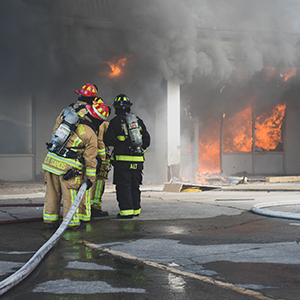
On January 25, 2021, crews responded to a fire in a two‑story warehouse attached to a single‑story retail store. Upon arrival, smoke was showing from the upper story of the warehouse, and occupants were still inside, prompting an immediate life‑safety‑driven interior attack. Firefighters advanced hose lines up two separate stairwells, one on the Alpha side and one on the Charlie side of the warehouse. Meanwhile, the truck company opened multiple vertical ventilation holes.
Without effective water on the fire, conditions worsened rapidly. High heat, zero visibility, and deteriorating structural conditions forced crews to withdraw, and several firefighters suffered burn and orthopedic injuries. The event underscored the challenges of size‑up strategies for commercial structures and the importance of fireground coordination strategies.
Conducting a Comprehensive Investigation into the Warehouse Fire
Following the incident, the department established a Serious Incident Review Team that worked in collaboration with the Fire Safety Research Institute to investigate the event. The analysis sought to understand why suppression efforts were ineffective and why interior conditions deteriorated so quickly. The work included:
- Fire modeling to simulate heat release rates, ventilation flow paths, and temperature conditions throughout the warehouse.
- Water distribution experiments to evaluate hose stream mechanics best practices in commercial buildings with high ceilings, exposed structural members, and obstructed layouts.
- Review of documentation, including video, photos, radio traffic, interviews, and damaged PPE to understand how firefighters were exposed to extreme thermal conditions.
- Assessment of building construction and fuel load, which revealed that compartmentation, fuel load, and limited access points contributed to rapid fire growth and reduced visibility.
This analysis helped explain how vertical ventilation increased oxygen availability and intensified the fire as well as why water applied from both ends of the warehouse often failed to reach the seat of the fire. This work provided a clear picture of how applying fire dynamics principles in commercial fires can prevent similar near misses and reduce firefighter burn injuries during warehouse fires.
“We are deeply grateful for the time, expertise, and professionalism the Fire Safety Research Institute team dedicated to assisting our Serious Incident Review Team with the analysis and comprehensive review of our commercial fire. Their thorough and objective report not only honors the firefighters who were injured but will serve as a lasting resource to strengthen training, improve safety, and advance the fire service for years to come.”
—Chris Manroe
Fire Chief
Chula Vista Fire Department
Key Recommendations for Safer Operations in Warehouse Fires
The Fire Safety Research Institute outlined several recommendations to help firefighters operate more effectively and safely in large commercial buildings:
- Strengthen commercial size‑up strategies by assessing ceiling height, fuel load, access limitations, and compartmentation before committing crews.
- Improve hose stream mechanics best practices by understanding how water behaves in high‑volume, obstructed spaces and adjusting tactics accordingly.
- Coordinate ventilation with suppression so that openings do not outpace water application and unintentionally intensify fire conditions.
- Enhance situational awareness by recognizing when tactical actions are not producing expected outcomes and adjusting quickly.
- Use thermal imaging more effectively by understanding its limitations and incorporating it into tactical decision‑making, rather than relying on it alone.
- Understand firefighter thermal exposure and the limits of PPE in high‑heat commercial environments.
This warehouse fire near miss highlights the importance of understanding how commercial buildings behave under fire conditions and how tactical decisions, especially ventilation and water application, interact with fire dynamics. The lessons learned reinforce the need for coordinated operations, strong situational awareness, and a deeper understanding of how fire behaves in large, fuel‑rich spaces. By integrating these findings into training and operations, departments can reduce the likelihood of firefighter burn injuries during warehouse fires and improve outcomes at future commercial incidents.
This report was made possible through a grant from the Department of Homeland Security Federal Emergency Management Agency’s Assistance to Firefighters Grant Program, Award EMW‑2018‑FP‑00476.